Bee Services

Pollination Services
Looking to improve crop yields in your residential garden or commercial agricultural operation?
We offer hives for rent in Northern Virginia, Southern Maryland, and surrounding regions. Click here to learn more!

Bee Swarm Removal and Relocation
Did you come across a honeybee swarm or hive in your yard? Are there bees living inside your home, garage, boat, RV, car, or other structure?
We offer honeybee swarm removal in Spotsylvania, Virginia and the surrounding Northern Virginia region. We also do some smaller Wasp and Hornet removal/relocation jobs. Click here to learn more!
Pollination Services

The presence of honeybees near food crops is known to increase crop yields. Honeybees can fly about two miles from their hive (sometimes farther), making it possible for them to assist in pollinating a large field or multiple areas.
Due to our limited number of hives, we currently cannot offer hives for pollination, however, we do plan to offer this as a service in the coming seasons, so please contact us if you are interested in securing a contract.
We are based out of Spotsylvania, Virginia but can transport hives to many of the surrounding regions! Please contact us for a quote based on your specific needs, no property is too big or too small to rent a hive!
Spotsylvania, VA
Spotsylvania, Fredericksburg, Stafford, Lake Anna, King George and Sumerduck regions
Northern Neck/Tidewater
All points south and east of Fredericksburg along US-17 and VA-3
NoVA
Fairfax and Loudon counties, Warrenton and Manassas regions.
Southern Maryland
Potomac and Patuxent corridors
DELMARVA
The eastern shore of Delaware, Maryland, and Virginia
Is your region near one of the ones listed above?
Drop us a line! We may still be able to work something out.
Bee and Wasp Removal and Relocation
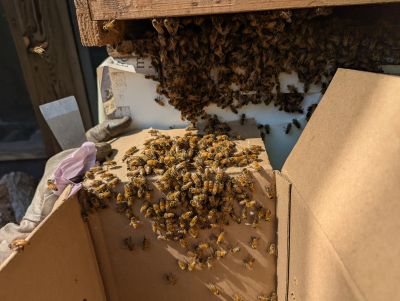
Honeybee Relocation
Come across a honeybee swarm or hive? Most local swarm removals are free of charge, and we offer affordable rates for the removal of bees that have moved inside of homes, outbuildings, vehicles, or other manmade structures.
There is no charge for honeybee swarms that are quickly and easily accessible.
Honeybee swarms located inside structures that require dismantle start at $200 and a signed waiver that absolves us of any damages incurred from the removal (we cannot replace or reinstall any building materials).
Call or Text us at (540) 805-BEES for a free assessment!
Wasp Removal and/or Relocation
While we mainly work with honeybees, we are happy to help remove and relocate other stinging insects as well. Many of these insects are also beneficial to pollination and not typically aggressive, but they often make the mistake of building their nests in high traffic areas which may result in defensive stinging.
We will review these requests on a case-by-case basis. We are currently not equipped to deal with yellow jackets, bald-face hornets, or other large-colony hornet species.
A typical scenario would be paper wasps or mud daubers nesting in a door frame or on a deck railing. We can attempt to relocate these beneficial pollinators and their nests to our bee farm where they can go about their natural lives.
Prices start at $50 per nest within the Spotsylvania Courthouse area. Larger or difficult to reach nests may cost more. Call or text (540) 805-BEES for a free estimate!
Honeybee Swarm Facts
What is a honeybee swarm?
What to do if you come across a swarm
What to do if you come across a swarm

Every spring or summer, as part of the reproduction process, approximately half of the bees leave, or "swarm" from the hive with their queen to search for a new home. The bees that decide to stay behind will make a new queen and start a new colony in the original location. By doing this, honeybees are able to grow their colony numbers and avoid extinction by not only reproducing as individual organisms, but as a super organism as well.
A bee swarm will often cluster into a ball shape and can be as large as a basketball! These swarms can be observed near the ground or up high in a tree, and may hang there for just a few hours or for several days.
The swarm will send out scout bees to look for viable hive sites. If they find one that they like, they will tell the rest of the swarm through a "waggle" dance. The cluster of bees will then fly to the new site and begin moving in.
All bee colonies will have the natural urge to swarm, whether in the wild or in "captivity," so it is very likely that a swarm you come across could have come from someone else's hive. Beekeepers do their best to prevent their bees from swarming naturally -- by manually splitting them early -- but swarming can still happen after the fact later in the season, especially if the beekeeper overlooks telltale signs of a coming swarm.
What to do if you come across a swarm
What to do if you come across a swarm
What to do if you come across a swarm
Remain calm! Swarms are generally harmless, but there is always a possibility for them to become defensive if provoked. It's best to leave them be and reach out to a local beekeeper (us if you're in Northern Virginia!) to have them relocated.
Relocation is ideal, as it is possible for the swarm to move into a structure, which may result in a possible nuisance to someone who may not enjoy the company of a few thousand bees. Swarm survivability in the wild is also statistically low, so they may starve before finding a new home if left to their own devices.
If the swarm is in close proximity to children, pets, or the general public, it is advisable to cordon off the area to help prevent beestings or injury to the swarm. Swarms can land on tree branches near sidewalks and building entrances. Remember, swarms are generally docile and unlikely to attack, but kids and pets may try to interact with them using a more hands-on approach.
Swarms can move quickly, so if you have a few minutes to spare, definitely admire the bees at work from a reasonable distance as they look for a new home. When they want to mobilize all at once, the cloud of bees that results is an incredible sight to see.
Bee Swarm Hall of Fame

My first encounter with a swarm during the summer of 2023. This cluster of bees was found near our tomato garden at our first home while we were in the process of moving. This was the moment I went from watching and reading about bees to ordering everything I needed to get started with beekeeping.
My first attempt to capture this swarm was unsuccessful. While I was able to cut the branch and lower it into a very large igloo cooler, the bees were not having any of it and they stung me on the nose.

Due to the fast moving nature of honeybee swarms, I quickly constructed a very crude box for this swarm to keep them around while I ordered a proper langstroth hive. They stuck around for about 2 days but ultimately decided it was not up to their specifications and they promptly left for a higher tree.
This original swarm after they decided they did not like the home made box. Unfortunately they relocated before I could find a way to capture them again.
My second encounter with a swarm was a call for bee removal from a residential building. The bees had taken shelter inside a decorative porch column. The queen had not yet laid any eggs, but the colony had just begun to draw comb.
Like the first swarm, this second encounter was very similar. The bees were hesitant to stay in even a proper hive with some drawn out honeycomb from an older colony. The bees would fly out at almost the same rate that I was scooping them into the box.